Cut Your Biggest Costs First: Housing and Food
Choose the Right Dorm and Save Money in Japan
Housing is your biggest expense as a student in Japan. The national average rent for international students is ¥41,000 per month — and in Tokyo, that jumps to ¥57,000. Those numbers add up fast.
The smartest move is to apply for a school dormitory early. University dorms cost between ¥20,000 and ¥60,000 per month. JASSO-affiliated dorms average around ¥28,000, and utilities are often partly included. That’s a potential saving of nearly ¥30,000 every month compared to renting a private room in Tokyo.
Spots fill up quickly, so apply as soon as your school opens the process. Don’t wait.
Eat Smart: Cheap Food Options for Students in Japan
Food is the second big cost to watch. The good news is Japan makes it surprisingly easy to eat well on a tight budget.
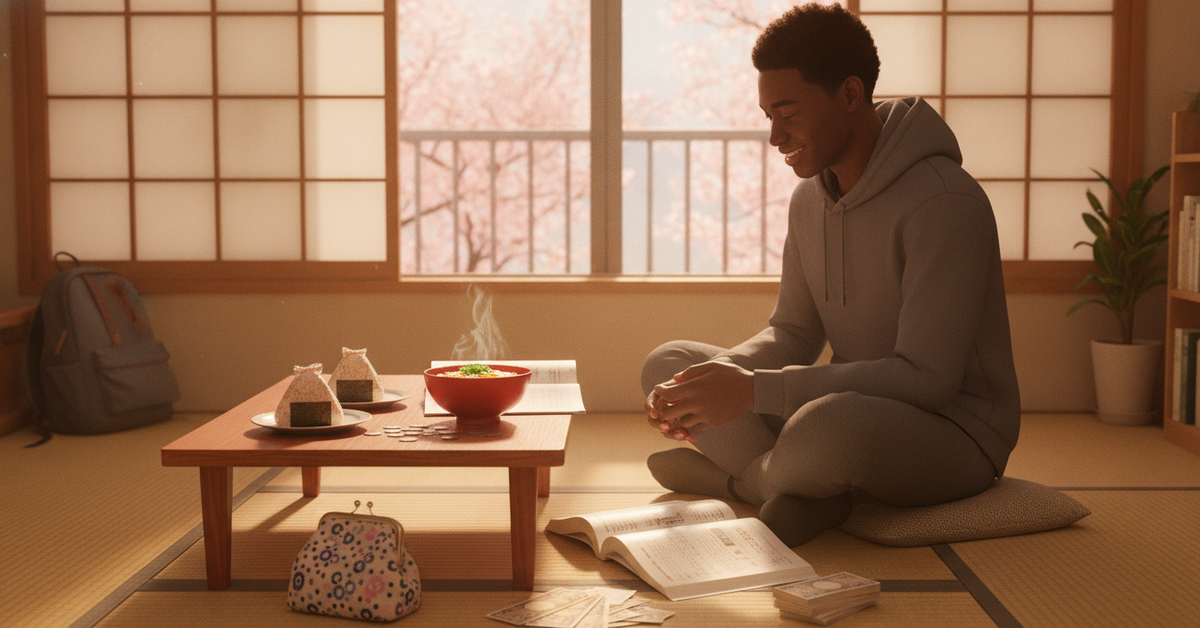
Your school cafeteria is your best friend. Meals there typically cost ¥300–¥500 and are designed with students in mind. Convenience stores are also a solid option — onigiri, sandwiches, and salads run about ¥200–¥500 each. Hit a supermarket after 7 p.m. and you’ll find marked-down bento boxes and fresh food at big discounts.
Cook at home when you can. Even simple meals save a lot over time. Small habits — like making your own lunch a few days a week — quietly cut hundreds of dollars from your monthly spend.
Make the System Work for You as a Student in Japan
Get Your Student Commuter Pass and Cut Travel Costs
Train fares in Japan feel small at first, but they stack up fast when you’re riding every day. A student commuter pass — called a 通学定期券 (tsugaku-teikiken) — cuts that cost by around 50% compared to a standard adult pass. That’s a serious saving over a full school year.
You load the pass onto a Suica or PASMO IC card. For your first application, you’ll need to go to a station counter in person with documents from your school. After that, renewals are straightforward. You can buy a pass for 1, 3, or 6 months — and the longer the period, the bigger the discount. If your budget allows, go for the 6-month option.
Earn Legally: Part-Time Work Rules Every Student Needs
A part-time job is one of the best ways to save money as a student in Japan — but you must get permission first. Before you start any work, check the back of your residence card for the permission stamp (資格外活動許可). Without it, working is illegal and can lead to serious consequences, including deportation.
Once you have permission, you can work up to 28 hours per week during regular school terms. During long breaks — summer, winter, and spring — that limit rises to 40 hours. Many students work at convenience stores, cafes, or restaurants. The pay helps cover daily costs and reduces how much you need from home each month.
Spend Less on Everything Else: Discounts and Smart Habits
Student Discounts in Japan You Didn’t Know Existed
Japan takes student discounts seriously. Always carry your student ID — many places won’t advertise their discount, but they’ll give it if you ask. It takes two seconds and saves real money.
Movie tickets are a great example. Students typically save ¥300–¥500 per ticket compared to the adult price. Museums are even better. Students at the University of Tokyo, for instance, get free regular-exhibition entry to Tokyo National Museum and the National Museum of Nature and Science. That’s world-class culture at zero cost. Check what your own school offers — many have similar deals through partner programs.
Free and Cheap Entertainment for Students in Japan
You don’t need to spend much to have a great time in Japan. Parks, temples, and local festivals are free. Shrines and gardens cost little or nothing to visit, and Japan has them everywhere. If you’re planning your time between study terms, the Japan National Tourism Organization has a useful guide to free and low-cost experiences across the country.
The JASSO Monbukagakusho Honors Scholarship is worth knowing about too. It pays ¥48,000 per month to international students who maintain a GPA of at least 2.30 out of 3.00. That’s not pocket money — it covers a big chunk of your living costs. Study hard, keep your grades up, and apply as soon as you’re eligible. Free culture plus a scholarship makes student life in Japan far more affordable than most people expect.