
What You Need to Open a Bank Account in Japan as a Student
Get Your Residence Card Address Updated First
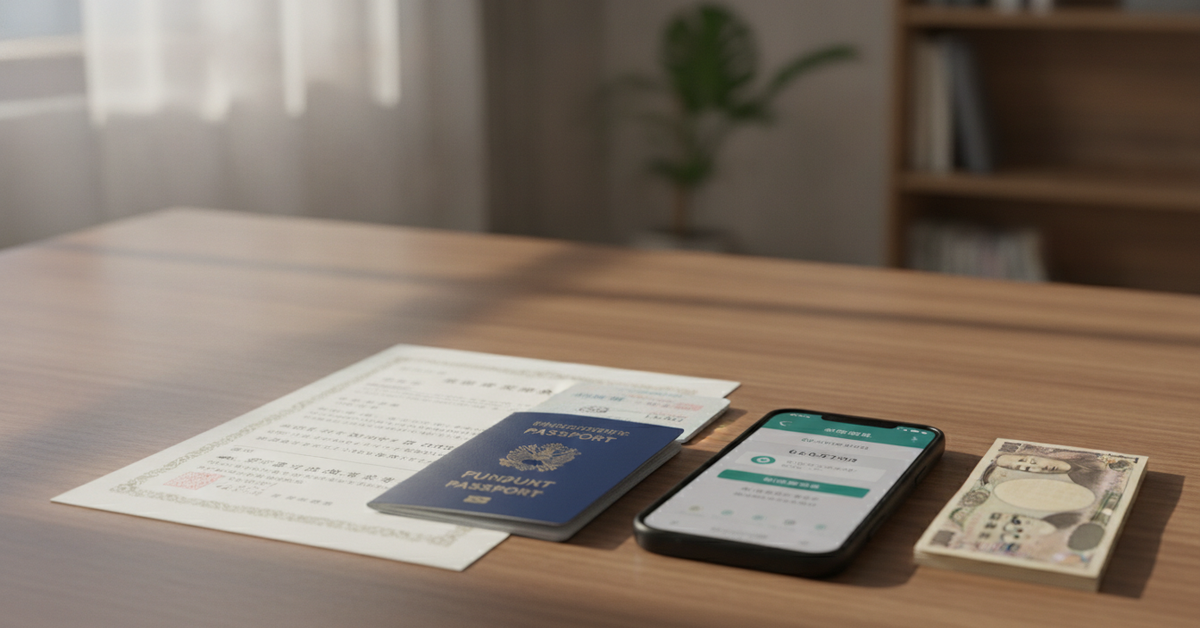
Your Residence Card (在留カード) is the single most important document you need. Every bank in Japan requires it — no exceptions. But here’s the part many students miss: the address on the back of the card must be your current Japanese address before you visit any bank.
You register your address at your local city or ward office. Japanese law requires you to do this within 14 days of arrival. When you go, bring your passport and Residence Card. The office prints your address directly onto the back of your card. You also receive a Juminhyo (住民票), which is your official proof of registration.
Don’t skip this step or put it off.
My Number and Japanese Phone Number: Both Required
Once your address is registered, Japan automatically assigns you a My Number (個人番号) — a 12-digit ID number. Banks have required it for all new accounts since 2016. It arrives by post within roughly 2–3 weeks. Most banks accept the notification letter while you wait for the card itself.
You also need a Japanese phone number. Banks send SMS codes during the sign-up process, and VoIP or internet-only numbers don’t work. Get a local SIM card early — ideally your first or second day. Many students pick one up at the airport.
As a student, bring your student ID or enrollment certificate too. This proves your status and is required in addition to your Residence Card.
Best Bank in Japan for International Students: Japan Post Bank
How to Open Your Yucho Account: Branch vs. App
Japan Post Bank (ゆうちょ銀行) is the best first bank for international students. It has no minimum balance, no monthly fee, and no strict long-stay requirement. You sign with your name — no personal seal (hanko) needed. To open an account, bring your Residence Card (with your address on the back), your My Number, your student ID or enrollment certificate, and ¥1,000 in cash for the initial deposit.
Branch hours run 9:00 a.m. to 3:00 p.m., Monday to Friday only. Go early in the week if you can — lines move slowly near month-end.
You can also apply through the Yucho Tetsuzuki app.
Fees, ATM Access, and the 6-Month Transfer Restriction
Japan Post Bank charges no monthly maintenance fee, which makes it ideal when you’re watching every yen. Your Yucho card works at all 24,000+ Japan Post ATMs nationwide and at every 7-Eleven ATM too — so you’re rarely far from cash, even in smaller cities.
One thing catches many new students off guard. Under Japanese law, students who have been in Japan for less than 6 months are classified as “non-residents.” This means your account will have limits on international wire transfers until that 6-month mark passes. You can still spend and receive money inside Japan without any issue. Just plan ahead if you need to send money home in your first few months.
Other Bank Options and Mistakes That Delay Your Application
SBI Shinsei Bank and Other Foreigner-Friendly Choices
Japan Post Bank is the easiest starting point, but it’s not your only option. SBI Shinsei Bank is a popular choice among international students and expats. It runs fully online, offers an English interface, and handles international transfers more smoothly than most Japanese banks. The initial deposit requirement is typically higher than Japan Post Bank’s ¥1,000, so bring extra cash just in case.
Some students also use Wise or Revolut alongside a Japanese bank account for cheaper overseas transfers. These aren’t bank accounts in the traditional sense, but they work well for sending money between countries. For a broader overview of student life finances in Japan, JASSO (Japan Student Services Organization) publishes useful guidance on living costs and financial planning for international students.
Common Mistakes That Get Your Application Rejected
The most common mistake is showing up at the bank before registering your address. Your Residence Card must already show your Japanese address on the back — banks check this every time. If the address field is blank, they’ll turn you away.
Tourist visa holders cannot open a bank account at any Japanese bank. You need a long-term residence status and a valid Residence Card. No exceptions exist. The Ministry of Foreign Affairs of Japan visa information page is the right place to confirm which visa categories qualify as long-term residence status.
Two more mistakes trip students up regularly. First, using a VoIP number instead of a real Japanese SIM — banks reject these for SMS verification. Second, arriving at the branch after 3:00 p.m. Bank counters close at 3:00 p.m. sharp, Monday to Friday.
Frequently Asked Questions
Do I need a hanko (personal seal) to open a bank account in Japan as a student?
No, Japan Post Bank does not require a hanko. You sign with your name, which makes it much more accessible for international students who haven’t acquired a personal seal.
Why can’t I just go straight to the bank when I arrive in Japan?
You need your current Japanese address printed on the back of your Residence Card before any bank will accept your application. That means visiting your local city or ward office first — within 14 days of arrival — to register your address.
How long does it take to receive my My Number, and can I open an account without the card itself?
Your My Number arrives by post within roughly 2–3 weeks of registering your address. Most banks accept the notification letter while you wait for the physical card, so you don’t have to delay opening your account.
Why can’t I send international wire transfers right after opening my Japan Post Bank account?
Under Japanese law, students who have been in Japan for less than 6 months are classified as non-residents. This classification places limits on international wire transfers until that 6-month mark passes, though you can still spend and receive money inside Japan without any problem.
What is SBI Shinsei Bank, and how does it differ from Japan Post Bank for students?
SBI Shinsei Bank is an online bank popular with international students and expats, offering an English interface and smoother international transfer options than most Japanese banks. The main trade-off is that its initial deposit requirement is typically higher than Japan Post Bank’s ¥1,000 minimum.
Do I need a Japanese phone number to open a bank account in Japan?
Yes, a Japanese phone number is required because banks send SMS verification codes during the sign-up process. VoIP or internet-only numbers don’t work, so getting a local SIM card within your first day or two is strongly recommended.